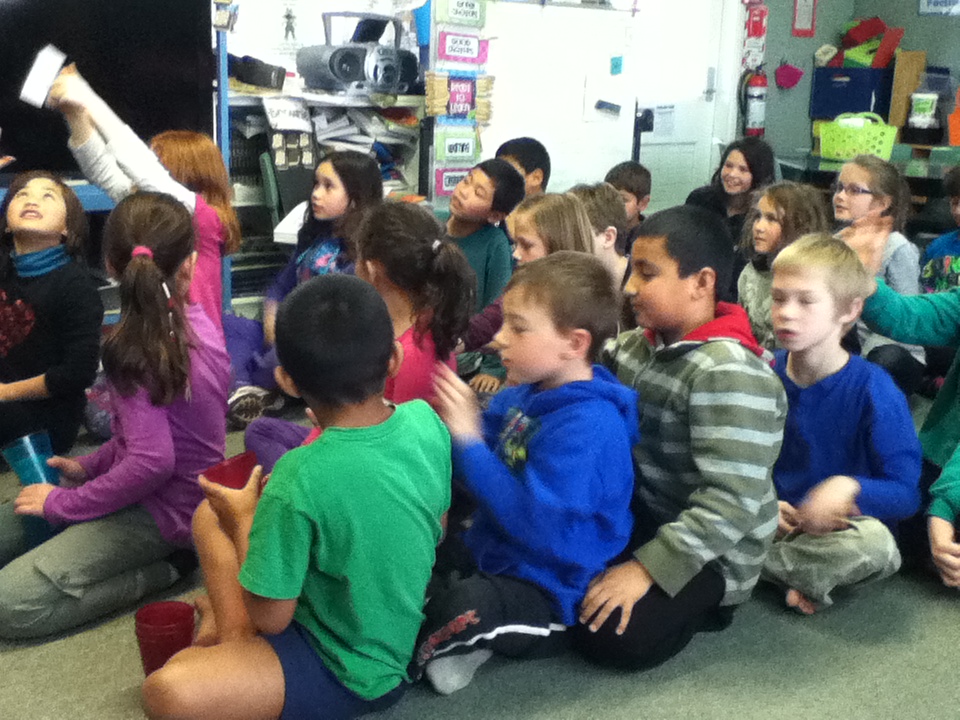
We are a class of year 3 and 4 children at Vardon School in Hamilton. The purpose of this blog is to share what we are learning with others. Click into our individual blogs to see samples of our work and reflections of what we did well and what we can improve on.
Showing posts with label Maths. Show all posts
Thursday, August 28, 2014
Tuesdays Weather Temperature
Room 9 noticed that between 10:00am and 11:00am the temperature rose 5 degrees. At 4:00pm the temperature was at its hottest being 15 degrees. The temperature got hotter as the day went on. I wonder what the weather is going to do tomorrow? What do you know about temperature?
Sunday, May 11, 2014
Pentagons-Two times tables
In the Pentagons we are learning to use our doubles to help us work out our two times tables.
Here is a Pic Collage we have made using materials to show groups of two.
Now we are practicing getting faster at answering our two times tables. Here is a game to practice it with.
http://www.wmnet.org.uk/resources/gordon/Hit%20the%20button%20v9.swf
We were allowed to play it three times and hopefully improve our score. Check out our individual blogs to see what scores we got for our three games and if we are improving.
Here is a Pic Collage we have made using materials to show groups of two.
Now we are practicing getting faster at answering our two times tables. Here is a game to practice it with.
http://www.wmnet.org.uk/resources/gordon/Hit%20the%20button%20v9.swf
We were allowed to play it three times and hopefully improve our score. Check out our individual blogs to see what scores we got for our three games and if we are improving.
Saturday, March 15, 2014
Maths-Place Value
At the beginning of the year we had to do the dreaded IKAN test. A super FAST maths test to see what we can answer quickly. One area we all need to practice as a class is our place value. So on Friday we did a quick activity with ice block sticks. Some were bunched together in groups of ten (these were our tens) and some were loose ice block sticks (these were our ones). Mrs Head then called out a number and we had to make that number with the ice block sticks and tell her how many groups of ten made up the number and how many ones there were.
Next time we try this we will use counters and tens frames.
As a side note it was great to see lots of the groups choosing to make tally marks with their ones to easily show how many ones you had, bringing some of your statistics knowledge into your number knowledge.
Next time we try this we will use counters and tens frames.
As a side note it was great to see lots of the groups choosing to make tally marks with their ones to easily show how many ones you had, bringing some of your statistics knowledge into your number knowledge.
What are some ways you practice your place value?
Monday, February 10, 2014
Statistics Vocabulary
To be successful with our statistics learning we need to understand what certain words mean when we use them to talk about our statistical investigations or when we read someone else's.
Today we are introduced the new language we will be using while we learn about statistics.
Friday, February 7, 2014
Welcome Back
Welcome back and welcome to our three new Vardon students who make up Room 9 this year. We have kicked the term off already with some writing and maths in between getting to know each other.
Here we are starting to look at statistics and learning how to write the number five using tally marks. Mrs Head said a number and we had to make it using iceblock sticks for the tally marks. Then we created a class tally chart about how we were all feeling about the first day back at school. From that we made a pictograph.
Friday, September 6, 2013
Measurement-Length
In Room 9 we are beginning to look at measurement and the different units there are for measuring length.
Here are a few different things we already know about measurement.
Wednesday, August 21, 2013
We are cashletes!
Today we had a financial personal trainer (PT) visit Room 9 to teach us about money, how to keep it safe and what we should do with it. We even found out that we can own an eftpos card when we turn eight if our parents sign for us to have one. We also learnt the difference between a credit card and an eftpos card. An eftpos card is our money but a credit card is the banks money and we have to pay it back. Just like if we borrow a pencil we have to give it back. Alex asked a great question so do we just pay that amount back? We learnt that you have a time that it must be paid back to the bank otherwise you pay interest on it. So like the pencil if you don't give that back in time you might have to give the pencil back plus a rubber or three pencils.We did some chores to earn some money and then talked about what to do with it and we decided it was best to spend some on me and save some too!
Saying our chant spend some on me and save some too!
Doing our chores to earn money.
Monday, August 12, 2013
Pentagons are learning their four times tables.
Today the pentagons maths group were using materials to help use their two times tables to work out their four times. Check out how we made four groups of 6 and four groups of 8 to show 4x6 and 4x8 using a variety of materials.
Monday, May 27, 2013
Oral Language
Every Tuesday for oral language we work together to share our strategies when solving our given maths word problems. First we have to read the problem and decide what it is asking us to do. Then we need to share the way we would solve it looking for the quickest way to get to the answer. Next we have to explain it so that everyone in our group understands the preferred strategy. Finally we share back with the class and always make sure we say what strategy we have used eg: using our doubles.
Thursday, May 9, 2013
Place Value Songs
The Hexagons are learning about place value.
We need to know how many tens are in a number and how many ones are in a number so that we can start adding two digit numbers together.
These songs helps us remember what number represents the tens and which number represents the ones.
We need to know how many tens are in a number and how many ones are in a number so that we can start adding two digit numbers together.
These songs helps us remember what number represents the tens and which number represents the ones.
Wednesday, March 20, 2013
Fractions with our class
This morning we started of our maths finding fractions using the people in our class. We were luck that we only had 20 people at maths time so it was a nice easy number to work with. We started off as a whole, then we split in half, then into quarters and then into one tenth.
Using our photos which show what one tenth of 20 is, I wonder if you can leave a comment to work out what one fifth of 20 is....
Tuesday, March 12, 2013
Fractions-What is a quarter of 16?
The Hexagons have been learning to find a fraction of a set. See how they work this problem out.
Tuesday, March 5, 2013
Fractions Song
We are learning about fractions being part of a whole.
Here's a little song that really helps us to understand what fractions are all about.
Thursday, October 18, 2012
Mathethon
Remember to keep practicing your maths for our mathethon in Week 2.
Click on the link below and scroll down to find the fun practice games.
http://www.studyladder.co.nz/about/fundraising-mathethon
Don't forget to keep collecting sponsors either.
Some other good websites to practice your multiplication (times) and division (divided by) are;
www.wmnet.org.uk/resources/gordon/tlit%20the%20button%20v9.swf
www.resources.oswego.org/games/mathmagician/mathsdiv.html
www.resources.oswego.org/games/sumsense/sumdiv.html
Click on the link below and scroll down to find the fun practice games.
http://www.studyladder.co.nz/about/fundraising-mathethon
Don't forget to keep collecting sponsors either.
Some other good websites to practice your multiplication (times) and division (divided by) are;
www.wmnet.org.uk/resources/gordon/tlit%20the%20button%20v9.swf
www.resources.oswego.org/games/mathmagician/mathsdiv.html
www.resources.oswego.org/games/sumsense/sumdiv.html
Friday, October 5, 2012
Enlargement Art
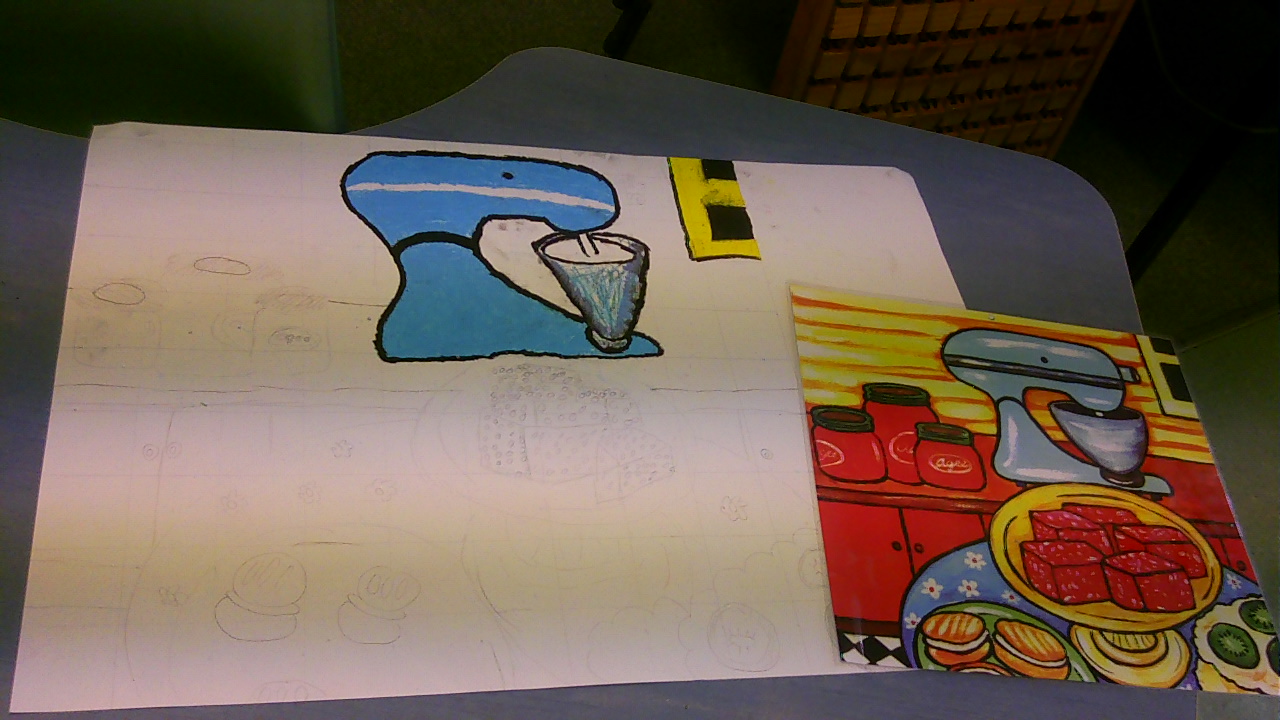
We have been learning about enlarging an object, shape or image as a nice way to end the term we have done some artwork which required us to enlarge. so we had to do the maths before we could get started on the art. We first of all choose a kiwiana picture and then we measured out grid lines 3cm apart. We then got our big sheet of paper and enlarged it making the picture 1.5times the size.
Check out our progress so far.
REMEMBER YOU CAN CLICK ON THE IMAGE TO 'ENLARGE' IT IF YOU WANT TO SEE MORE OF A CLOSE UP.
Check out our progress so far.
REMEMBER YOU CAN CLICK ON THE IMAGE TO 'ENLARGE' IT IF YOU WANT TO SEE MORE OF A CLOSE UP.
Tuesday, August 14, 2012
Maths Week 2012
This week is maths week so we have been doing some problem solving. Check out how we worked out the problem below.
Wednesday, August 1, 2012
Magic Maths
We are learning some sneaky maths tricks in Room 11 to have lots of fun exploring maths. The first challenge was to make a hole in an A4 piece of paper big enough for Mrs Head to step through. It couldn't have any holes in the link or be cellotaped or stapled together.
Check out how we went. Some of us knew we needed to increase the actual area of the piece of paper because there was no way we were going to fit through a simple circle in the middle of the page.
Tuesday, July 31, 2012
Mailbox Maths
This week we have got a problem from James from the book James and the Giant Peach.
Here is a copy of the letter we got from him.
We got into groups with people from the Pentagons, Hexagons and Diamonds maths groups and talked about how we would solve this problem.
We quickly realised we needed to know how many grams fit inside one kilogram and it was lucky that we knew 1000g=1kg.
After we had discussed how to work it out with our groups we came back together as a class and shared our strategies before writing our letter as a class back to James.
You can see what we wrote back to him below,
Here is a copy of the letter we got from him.
We got into groups with people from the Pentagons, Hexagons and Diamonds maths groups and talked about how we would solve this problem.
We quickly realised we needed to know how many grams fit inside one kilogram and it was lucky that we knew 1000g=1kg.
After we had discussed how to work it out with our groups we came back together as a class and shared our strategies before writing our letter as a class back to James.
You can see what we wrote back to him below,
Dear James,
We know how much you guys can each eat of the peach without sinking.
How we worked it out was we knew that 1kg=1000g. So another 1000g equals 2000g that makes 2kg the amount of peach you said you could eat altogether. If there are four people we need to split the 2kg up so they each get the same. We started by splitting it in half to get 1000g this is enough peach for two people. Next we had to split it up in half again to find what a quarter of 2kg is. We did this by going half of 1000g is 500g. We checked our answer of 500g each by going 500g+500g=1000g (or 1kg). Then 1000g+1000g=2000g (or 2kg). We hope you land on the shore safely and that you remember to only eat 500g of the peach each.
Yours Sincerely,
Room 11 and Mrs Head.
Friday, July 27, 2012
Mailbox Maths
We have a special maths mailbox in our class now. Twice a week a letter appears in our mailbox and it always seems to be from a character that we have got to know through our stories Mrs Head reads. The character writes us a letter with a maths question they are having trouble solving. We try our best to work it out and then we write a quick letter back to reply to the character. Sometimes we use our oral language time to talk about possible answers and the strategies we have used to get to these answers other times the letter is read out and stuck on the whiteboard for us to go up and show our working on before writing the letter.
This helps us with reading (reading the letter), maths working with word problems understanding if we have to use plus, take-away, times or divided by and explaining our strategy. It also helps with our writing when we have to follow the structure of a letter to write back to the character.
Take a look at some of the examples of our recent mailbox maths.
Dear Your Majesty The Queen,
We have worked out your problem that you were having trouble solving.
First we started with the two minutes and added that with the three minutes that equals five minutes.
Then five minutes plus five minutes equals 10 minutes.
Then 10 minutes plus 10 from the 12 gives us 20 minutes then we added on the two from the 12 to give us 22 minutes.
Next we added 22minutes plus 6 minutes equals 28 minutes.
Lastly we got the two lots of 30 seconds which added together makes 1 minutes. So 28 plus 1 equals 29 minutes.
This means you listened to speeches for 29 minutes.
Yours Sincerely
Room 11 and Mrs Head.
Mrs Head found this new idea when she was looking on another teachers blog to find out more check out http://thefirstgradeparade.blogspot.co.nz/
This helps us with reading (reading the letter), maths working with word problems understanding if we have to use plus, take-away, times or divided by and explaining our strategy. It also helps with our writing when we have to follow the structure of a letter to write back to the character.
Take a look at some of the examples of our recent mailbox maths.
Dear Your Majesty The Queen,
We have worked out your problem that you were having trouble solving.
First we started with the two minutes and added that with the three minutes that equals five minutes.
Then five minutes plus five minutes equals 10 minutes.
Then 10 minutes plus 10 from the 12 gives us 20 minutes then we added on the two from the 12 to give us 22 minutes.
Next we added 22minutes plus 6 minutes equals 28 minutes.
Lastly we got the two lots of 30 seconds which added together makes 1 minutes. So 28 plus 1 equals 29 minutes.
This means you listened to speeches for 29 minutes.
Yours Sincerely
Room 11 and Mrs Head.
Mrs Head found this new idea when she was looking on another teachers blog to find out more check out http://thefirstgradeparade.blogspot.co.nz/
Monday, May 7, 2012
Practicing our times tables
We are learning our times tables and division in maths. We are using these songs to help us learn them so that we can answer them straight away. We have learnt little tricks like using our doubles to answer our two times tables and skip counting in fives or tens. We can also use what we already know from our two times tables to help work out our threes.
Subscribe to:
Posts (Atom)